

I have always loved using Microsoft Visio to create Enterprise Integration documentation. That passion led me to create the Microsoft Integration and Azure Stencils Pack for Visio. This package contains fully resizable Visio shapes and icons. They help you visually represent on‑premises, cloud, and hybrid integration scenarios. You can easily design enterprise architectures with BizTalk Server, API Management, Logic Apps, Service Bus, Event Hub, and other Azure technologies.
Many of you know me as a Microsoft Azure MVP with a strong focus on Enterprise Integration. I am also a former Visio MVP. For these reasons, I had very high expectations for this book.
Based on the title Visualize Complex Processes with Microsoft Visio, I expected something different. I was looking for real‑world cases, complex scenarios, advanced design techniques, and detailed implementation strategies. However, I quickly realized that the book follows a different approach.
Was I disappointed? No. I chose the book based only on its title. I did not read the description or the table of contents. I cannot criticize the book for my own assumptions. In fact, I was surprised by how many small but valuable things I learned while reading it.
📝 One-Minute Brief
An honest review of Visualize Complex Processes with Microsoft Visio, highlighting what the book does well and who it is best suited for. A solid guide for professionals looking to improve their Visio skills, understand diagram types, and collaborate more effectively using Microsoft Visio.
For me, this book is an excellent guide for professionals who want to learn or improve their Visio skills, rather than design truly complex processes. That said, the authors still share several best practices that help readers move in that direction. In addition, the book walks you through the different diagram types and explains the various Visio versions available.
It also shows how to work effectively with Visio and how to manually create flow diagrams. Moreover, it explains how to use data sources, collaborate securely, and share diagrams with others. Finally, it covers how to integrate Visio with Microsoft applications and BPMN.
Overall, I enjoyed reading this book. For that reason, I recommend it to anyone who wants to learn Visio or enhance their existing skills.
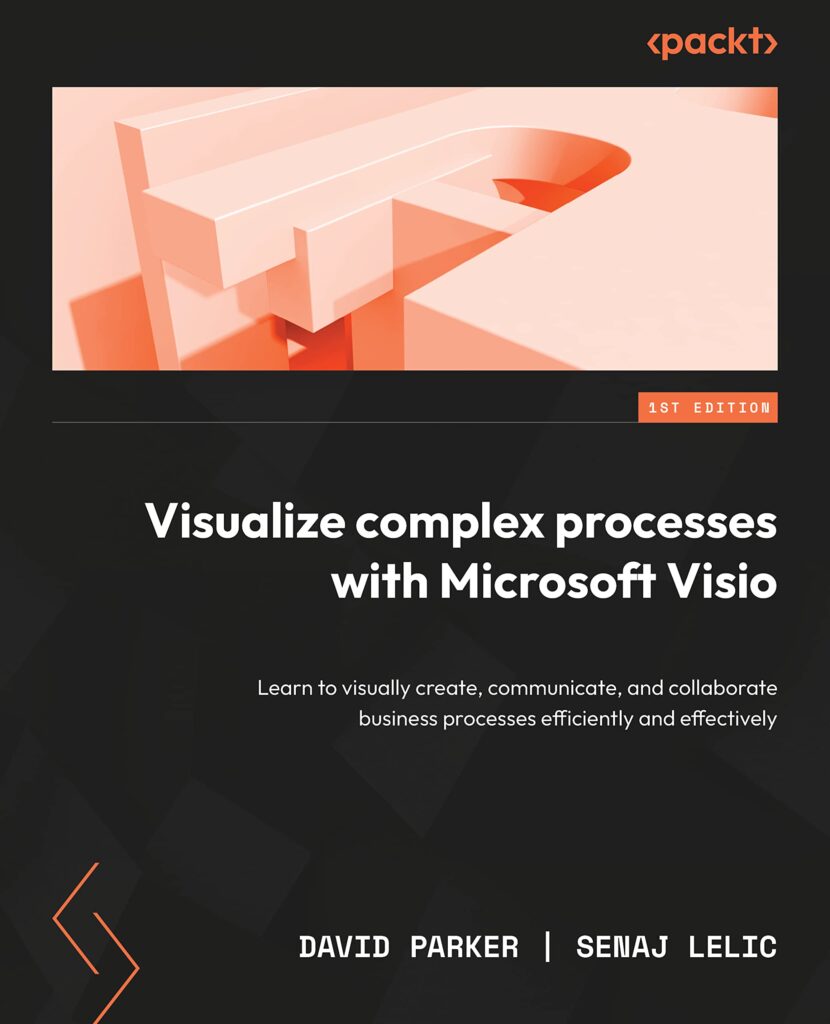
Visualize Complex Processes with Microsoft Visio Book Description
Every business has process flows, but not all of them are fully described to or verified for accuracy with each stakeholder. This not only presents a risk for business continuity but also removes the ability to make insightful improvements. To make these complex interactions easy to grasp, it’s important to describe them visually using symbology everyone understands. Different parts of these flows should be collaboratively developed and stored securely as commercial collateral.
Visualize Complex Processes with Microsoft Visio helps you understand why it is crucial to use a common, systematic approach to document the steps needed to meet each business requirement. This book explores the various process flow templates available in each edition of Microsoft Visio, including BPMN. It also shows you how to use them effectively, with tips, techniques, and examples, to reduce the time required to create them, as well as how to improve their integration and presentation.
By the end of this book, you’ll have mastered the skills needed to create data-integrated business flowcharts with Microsoft Visio, learned how to effectively use these diagrams collaboratively, but securely, and understood how to integrate them with other M365 apps, including Excel, Word, PowerPoint, and Power Automate.
What you will learn
- Choose an appropriate flowchart diagram type to describe the process steps.
- Develop the skills to efficiently use Visio to draw process flowcharts.
- Discover how to create process flow diagrams to meet the BPMN standard.
- Find out how to synchronize Excel tables with Visio process flowcharts.
- Store flowcharts securely and collaboratively.
- Understand how to export flowcharts and data to other M365 apps.
- Discover how Visio ShapeSheet functions can increase productivity.
Who is this book for
Suppose you’re a manager, analyst, or designer of business processes. In that case, this book will help you create professional process diagrams effectively and consistently to improve communication accuracy and facilitate impactful insights. This book will also be helpful for beginners or power users seeking tips and techniques to capture process flows from context and customize diagrams to meet academic and corporate standards.
Hope you find this helpful! If you liked the content or found it useful and would like to support me in writing more, consider buying (or helping to buy) a Star Wars Lego set for my son.



