

In some scenarios, you may run into issues that a simple adjustment can easily resolve. For instance, when working with BizTalk Server, you might already have both the receive port and send port configured. As a result, it’s natural to expect that when the receive port picks up a file from the receive location, BizTalk will process that file and drop the output into the send location.
However, that assumption is not always correct. Even if both ports belong to the same BizTalk Application, BizTalk will only process the message if the send port successfully subscribes to it. Therefore, if no subscription exists, BizTalk will not route the message. Consequently, the message will remain unprocessed, and you will encounter an error similar to the following:
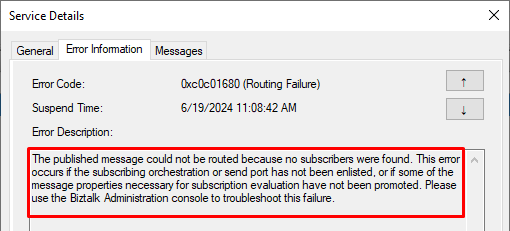
The published message could not be routed because no subscribers were found. First, you need to understand that everything that happens within BizTalk Server relies on its core publishing-subscribing architecture. By saying that, this error occurs if the subscribing orchestration or send port has not been enlisted, if some of the message properties necessary for subscription evaluation have not been promoted, or if you have not created/set a subscriber. We may need to use the BizTalk Administration console to troubleshoot this failure.
So how can you solve this problem?
📝 One-Minute Brief
Ensuring proper message subscription is fundamental to how BizTalk Server processes and routes messages. In this article, you’ll learn how message context, message types, and filter expressions impact subscriptions, and why misconfigurations can prevent orchestrations or send ports from receiving messages. Understanding this behavior helps troubleshoot routing issues, avoid message suspension, and design more reliable BizTalk Server integration solutions.
Solution
For the basic stuff, prof-of-concepts, or file routing, normally, this is quite simple:
- Double-click on your Send Port.
- Click on the Filters tab.
- On the Property column, select:
- BTS.ReceivePortName.
- On the Operator column, select:
- ==
- On the Value column, write:
- The name of your Receive Port Name.

This is the most used filter configuration for routing and subscribing to messages in POC or file routing.
Now, once you place your file in the receive location, BizTalk will recognize a subscriber to the message on the send port, allowing it to process and route the message correctly.
Of course, this does not cover all the possible scenarios, but it can help you figure out why your message subscription is failing.
Remember, having a send port does not ensure that you have a subscriber to the message.
Hope you find this helpful! If you enjoyed the content or found it useful and wish to support our efforts to create more, you can contribute towards purchasing a Star Wars Lego for Sandro’s son!