
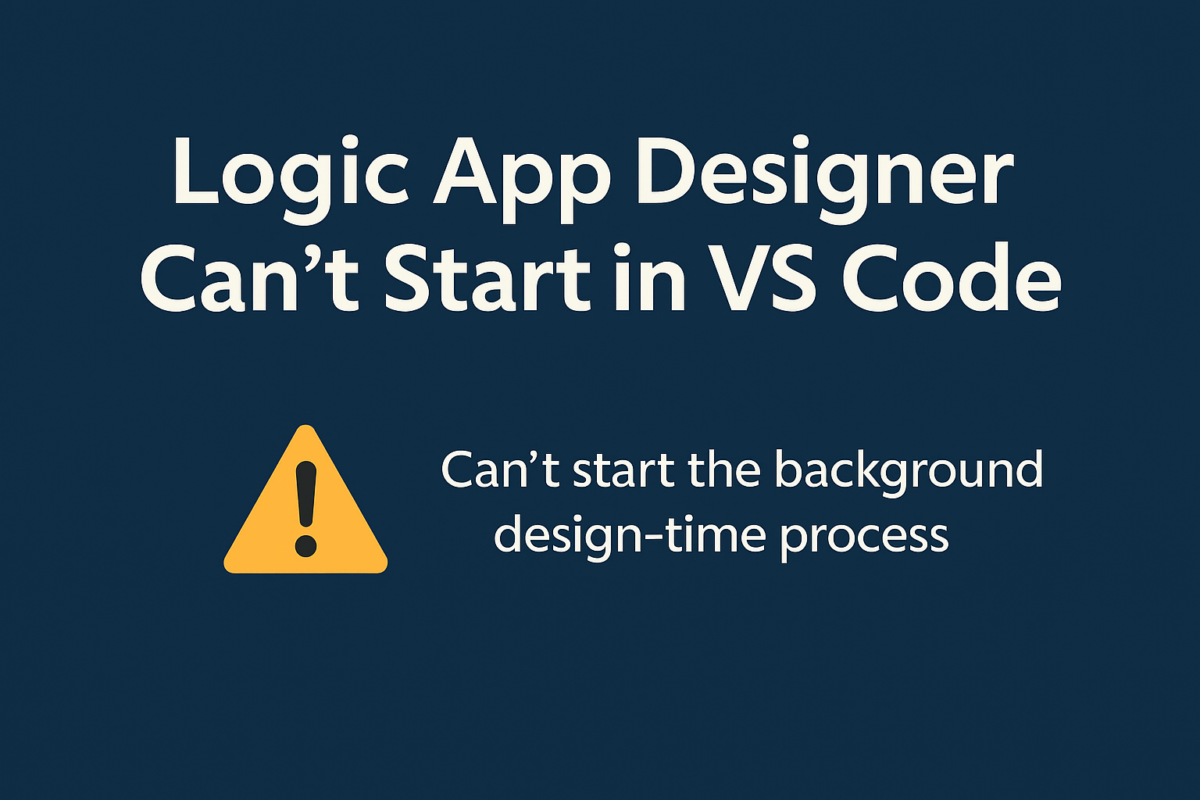
Today I was helping the team with a strange Logic app design issue, which meant I was back to my favorite topic: Errors, Warnings, Causes, and Solutions!
You know those days when nothing changes, yet your tools suddenly decide to stop working? That’s exactly what happened to me when I tried to open the Azure Logic Apps (Standard) designer in VS Code and got hit with two lovely messages:
Can’t start the background design-time process.undefined

And:
Unhandled exception. System.IO.FileNotFoundException: Could not load file or assembly ‘System.Runtime, Version=8.0.0.0, Culture=neutral, PublicKeyToken=b03f5f7f11d50a3a’. Impossibile trovare il file specificato.
File name: ‘System.Runtime, Version=8.0.0.0, Culture=neutral, PublicKeyToken=b03f5f7f11d50a3a’

If you’re seeing this, good news: your workflow is probably fine. The problem is almost always the local design-time runtime that VS Code uses to run the designer.
What’s actually failing?
When you open a workflow in the VS Code designer, the extension starts a local design-time host. Under the hood, VS Code launches Azure Functions Core Tools (the func host start process) to bring up the design-time API.
If that host can’t start (missing binaries, mismatched versions, broken cached dependencies), VS Code fails with the generic:
- Can’t start the background design-time process.
And if the host starts but can’t load the required runtime assemblies, you’ll see .NET errors like missing System.Runtime, Version=8.0.0.0.
📝 One-Minute Brief
Opening the Azure Logic App designer in VS Code can suddenly fail with the error “Can’t start the background design‑time process”, often followed by missing assembly exceptions such as System.Runtime 8.0.0.0. This article explains what causes this issue, why it commonly appears after tooling updates, and how to restore the local design‑time environment so the Logic App designer works again.
Cause
If you get this behavior, these are the usual culprits:
- Corrupted / partially updated local dependencies cache
- The Logic Apps extension downloads tools into a local folder (Functions Core Tools, Node, .NET runtime). When an update goes wrong, the designer host fails to boot. A widely suggested workaround is to delete the cached dependencies folder and let VS Code reinstall them.
- Version mismatch with the design-time runtime
- Functions Core Tools issues
- Another frequent root cause: Core Tools doesn’t start correctly or isn’t found, so the design-time API never comes up.
Solution
To solve these problems, perform the following steps:
- Step 0 — Close VS Code completely.
- Step 1 — Nuke the local Logic Apps dependency cache (most effective fix)
- Delete everything that is inside this folder:
- C:\Users\<your-user>\.azurelogicapps\dependencies
- This forces the extension to re-download the required tools and runtimes. This exact workaround is the first recommended action when the design-time won’t start.
- Reopen VS Code and wait for the extension to reinstall dependencies.
- Delete everything that is inside this folder:
- Step 2 — Try the designer again
- Right-click your workflow → Open in Designer.
Without those steps, I was able to fix the problems we were having.
Prevention tips (so it doesn’t happen again)
These are practical habits that reduce recurrence:
- If the designer breaks after extension updates, delete the
.azurelogicapps\dependenciesfolder first — it’s the fastest reset and a known workaround. - Keep your Functions Core Tools usable (
func --version) because the designer depends on it. - Ensure .NET 8 runtime remains installed and healthy.
Hope you find this helpful! If you liked the content or found it useful and would like to support me in writing more, consider buying (or helping to buy) a Star Wars Lego set for my son.